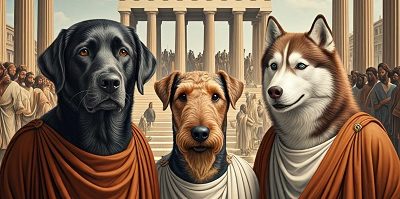
Mystic Animal
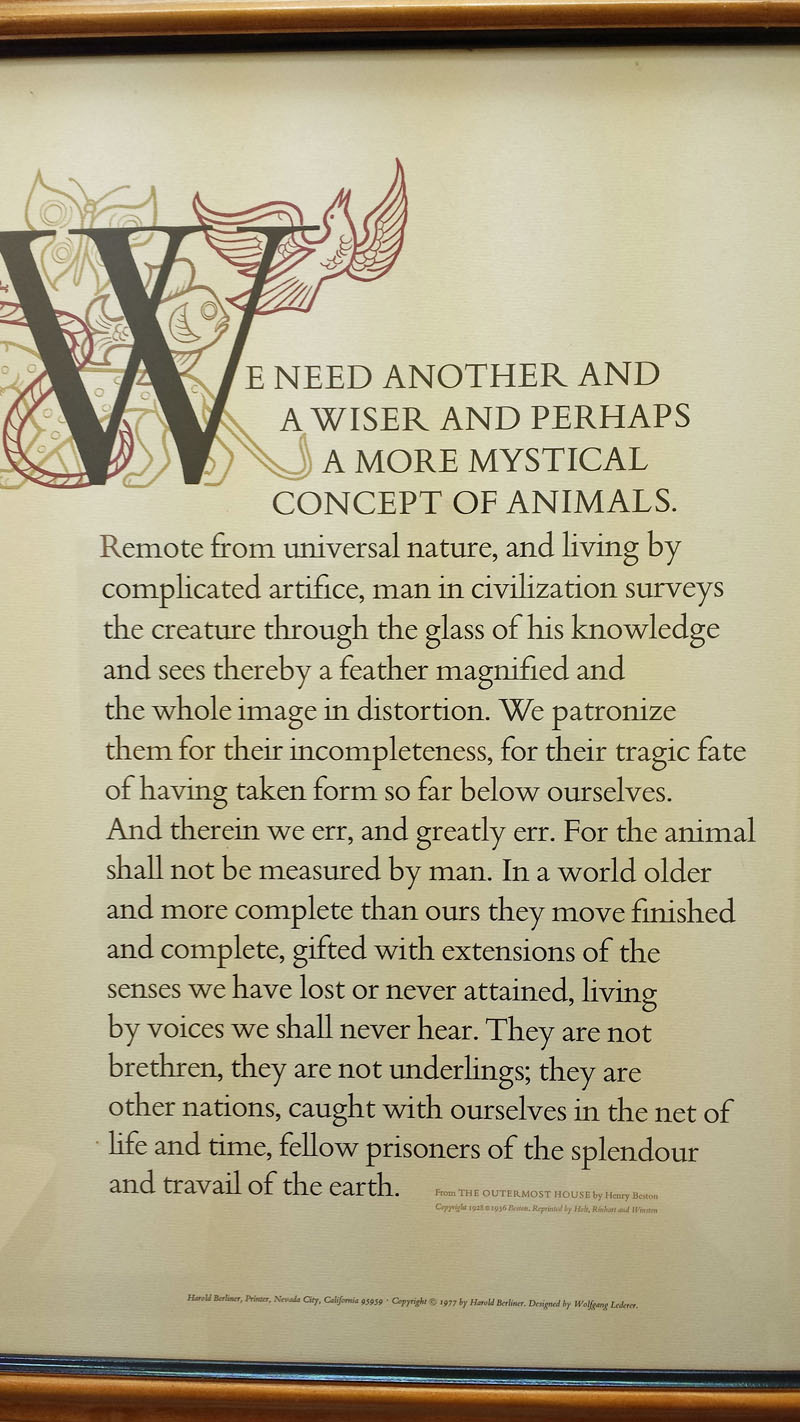
Framed and hanging on the wall in an exam room at our veterinarian’s office:
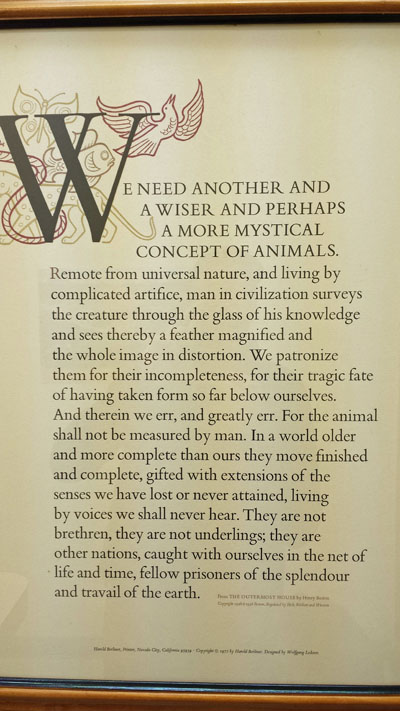
BIGGER. (From: The Outermost House, by Henry Beston).
I want to believe every word of this is true.
Framed and hanging on the wall in an exam room at our veterinarian’s office:
BIGGER. (From: The Outermost House, by Henry Beston).
I want to believe every word of this is true.
Another moody morning outside, brindled clouds with unclear intentions.
Happy Wife texts me from the conference. The keynote talk, which she left not half way through, was delivered by an optometrist on national health care. My God, what possibly could be worse, decaf coffee? A baseball game tied 0-0 in the bottom of the ninth? Hey, want to watch paint dry, follow me!
Good grief.
The goal of an early morning keynote is to enliven the attendees, not to induce somnolence.
I texted her back: Just go shopping for cryin out loud.
Our daily rag had an article raising concern for moose in Kincaid Park. Followers of this blog know that the dogs and I are at Kincaid park nearly every day of the week. Two moose were recently shot and killed there, one because children were being threatened, the other in self defense. It’s true that moose can be particularly surly during rut, one needs to be careful. Years ago Happy Wife and her dog at the time were pinned down by a bull moose, and eventually rescued by police who shot and killed it. A tragicomic story she retells well.
Anyway, in the article, some dude claimed the problem at Kincaid park is menacing dogs off leash:
To Doug Lloyd the solution is simple.
“Get all the damn unleashed dogs out of this park,” said Lloyd, a wildlife photographer and Department of Corrections retiree.
Lloyd has been photographing moose in Kincaid since 1981.
On a sunny day last week, he and Rob Tappana, another wildlife photographer, were watching a bull with an impressive rack eat its way along the edge of the Lekisch Trail, near the stadium.
Tappana, who retired from the U.S. Air Force, also saw new mountain biking trails and unleashed dogs as central to what he agreed was a growing problem for Kincaid’s moose.
What a load of dog crap. I’ve been walking/running dogs off lead in that park almost as long as he’s been photographing moose there, and I can’t recall a single instance, not one, of an off leash dog (even many dogs) threatening the life of a moose. I’ve witnessed plenty of the reverse of course, pissed off moose charging, and in some cases, stomping dogs. People too. Who knows, one day it might happen to a photographer.
Water in the outside dog bowl was in the liquid phase this morning. The puzzled look on Harry’s face when it’s solid, watching him lap a pie-shaped icicle, priceless.
Happy Wife left us for a conference in Seattle. No worries. Once she sees the proverbial pasture is no greener she’ll come running, begging us — please! — to take her back. Ha!
Now, I did note among the clothes in the staging area on the bed, where clothes are placed before transfer to luggage, the slimming dress, high heels, and, was that a necklace?
“Well,” she says, “you said you wanted me to look nice for my night out with Beth.”
Careful what I ask for I guess. She greatly underestimates her allure when dressed this way. The heads I see turn she thinks I imagined. A case of feigned jealously meets true modesty.
“Well, sure, but, uh… that nice?”
Alas, it was too late. Into the luggage the clothes went, a thorough good-bye pet to each of the dogs, and she and I were off to the airport. Outside the car it was hugs and kisses aplenty, yet all I could think of to shout to her as she walked away pulling that suitcase behind her was, “Don’t talk to strangers!”
There’s a remnant of a typhoon swirling in the Gulf of Alaska bringing with it tropically warm, moist air. I don’t mind that so much, hell, given it’s October 28th 55o feels like getting spoiled, just wish it wouldn’t bring it at 3 am in the morning at speeds > 90 MPH. It was about that time last night that I walked downstairs naked to investigate the noise on the deck; from our bedroom it sounded like the grill was taxiing for takeoff. It’s a special kind of vulnerability one feels when naked, trundling down stairs into the darkened spaces of the first floor, feeling for what is familiar by day but treacherous by night — chairs, bureaus, tables, jutting corners here and there — and trying to make out with half-opened eyes Harry’s form — where is he?, on his bed?, asleep on the chair?, stretched out on the floor where I don’t expect him? — hoping to avoid a calamitous fall on unprotected parts.
Just sayin’.
Saw the Packers bring down some serious whoop ass on the Viqueens last night. On the ground no less. Can’t recall the last time the Packers were a threat with the run game. Timely, too, given three of Arron Rodger’s top targets are injured. Looked like a playoff bound team to me last night, that’s for sure.
I can hardly talk about Sweat Pea. Yes, she’s recovering well, but that incision, my God, it must be 6-8 inches long, and the amount of fur that was shaved to do the surgery left most of her neck bare, so Happy Wife keeps it covered with a bandana (or two) and a bootie on her right paw to prevent her from scratching herself raw. That, and last night Happy Wife made salmon quiche cups to take to the vet staff this morning as a thank you for caring for Lucy. How sweet is that, you ask? Sure, super sweet, of course. However, let the record show that yours truly did not receive one — not even one — of those salmon quiche cups.
A news link caught my eye this morning: Will you have enough to retire? So I bit.
Inputs were simple, 1) current age and desired retirement age, 2) how much saved so far, 3) annual salary and 4) present savings rate. I put in some numbers: 53 and 67, a million bucks, $185K/yr, and 20%. Result: Supposedly, we will need $3.9 million to retire, but with these numbers we will fall short, we will only have $3.2 million.
How can this be? $4 million to retire? Srsly? Divide by two (half to me, half to Happy Wife), and say we both live 20 years beyond retirement, that leaves $100K per year each of us can spend for 20 years. What’s the problem? I am quite sure that together we can subsist in our doddering years on far less than $16,800K/mo, no? And that doesn’t count interest on our savings, social security (no laughing), or our home equity (2), which, even by a conservative estimate should be significant by the time we retire. Phooey, I say, phooey.
Woke up and felt almost instantly like sitting this one out. The thought of Lucy in the O.R. for a third time in as many months left me wanting to retreat beneath the covers, snuggle up against Happy Wife — who was anything but this morning, understandably, for the same reason as me — and wish the day away. Eventually I caved, rolled out of bed and paused at the window to stare at the blackness outside. Some people think black represents the addition of all colors, I know I did. When I was a kid I once took a colored crayon from the box of 64 and scribbled on a sheet of paper, then took the next crayon and scribbled on top of the first scribble, and kept going like that until I’d used every crayon. The result wasn’t black, not exactly, but it sure as hell wasn’t white, the sum of all wavelengths of visible light, the color of purity, cleanliness, enlightenment. Black means portents and I wanted none of those this morning, so downstairs I went to throw on some lights.
By the time I’d made Happy Wife her latte — Egg Nog infused, it’s that time of year — and got her and Lucy out the door and on their way to the vet, the sun had fought back the dark to reveal a constipated sky, which, had it let loose and cried like I felt like doing, surely it would have come as snow. Snow white snow.
But it wasn’t to be, no white snow, not for us, not yet anyway. I settled into my morning, got some meaningful work done, then called a close colleague who lives in Cleveland. He told me it snowed there late last night/early this morning. He and I co-published a number of papers together back when I was in grad school, so earlier this year when I was invited to contribute a chapter to a book to be published by Springer next year, I thought I’d invite him to be a co-author. Reason being that we’d already written a book chapter together, a book that never did get published for reasons unrelated to our contribution, and so we figured we could re-purpose the effort for this book. That was back in June; the due date for our contribution is December 1st, something I was gently reminded of this morning by the book’s editor.
By then Harry was anxious for a walk. I gulped back the last of my second coffee, changed clothes, and together we piled into the car and drove to Kincaid Park to our usual trails, under the cover of bloated clouds, me with hands in pockets scuffing along, missing the company of Sweat Pea and wondering how she was faring.
Lucy’s having a third mast cell tumor removed in as many months on Thursday. Damn thing keeps coming back, in the same location no less, despite good surgical margins.
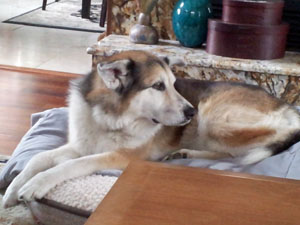
This girl’s a survivor though. No question about it.
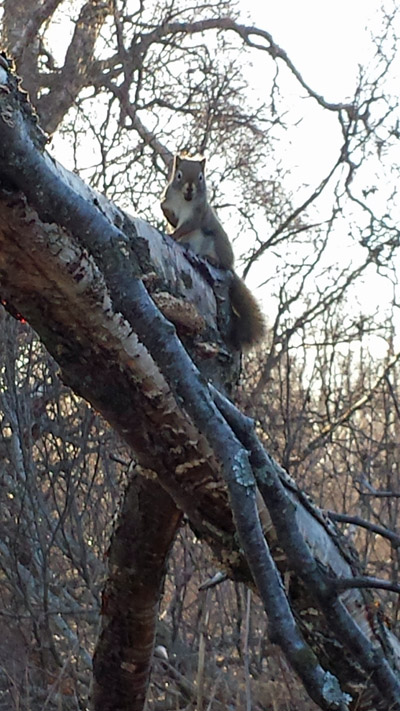
Squirrel: (In sophisticated sotto voce — think Brian on Family Guy):
“Well, hello there. Admiring my exquisite tail are we?”
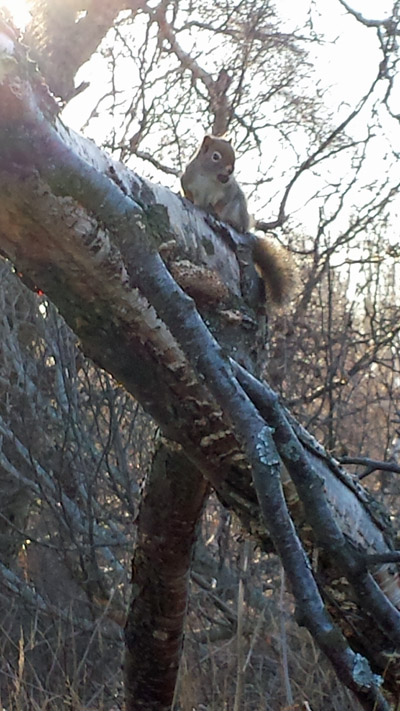
Me: “Dude, it looks kinda gay.”
Squirrel (think Richard Pryor): “Say what, MoFo?!”
A chilly, wet morning. A restless sky. Swollen clouds gray brown and roiling in mountain valleys, shrouding peaks. A morning to cinch your comfys tight, stoke the wood stove, wrap your hands around a steaming cup o’ coffee and stay inside.
So we didn’t.
On our beach walk we spotted a sucker hole or two open suddenly, then just as quickly close up again. Just like the rain, which came hard in sheets for a minute or less and then stopped in an instant, like the chorus howl of kennel dogs, whipped into a frenzy one moment, and then as if the lead dog stood atop his house and swiped a paw across his neck, stone silence.
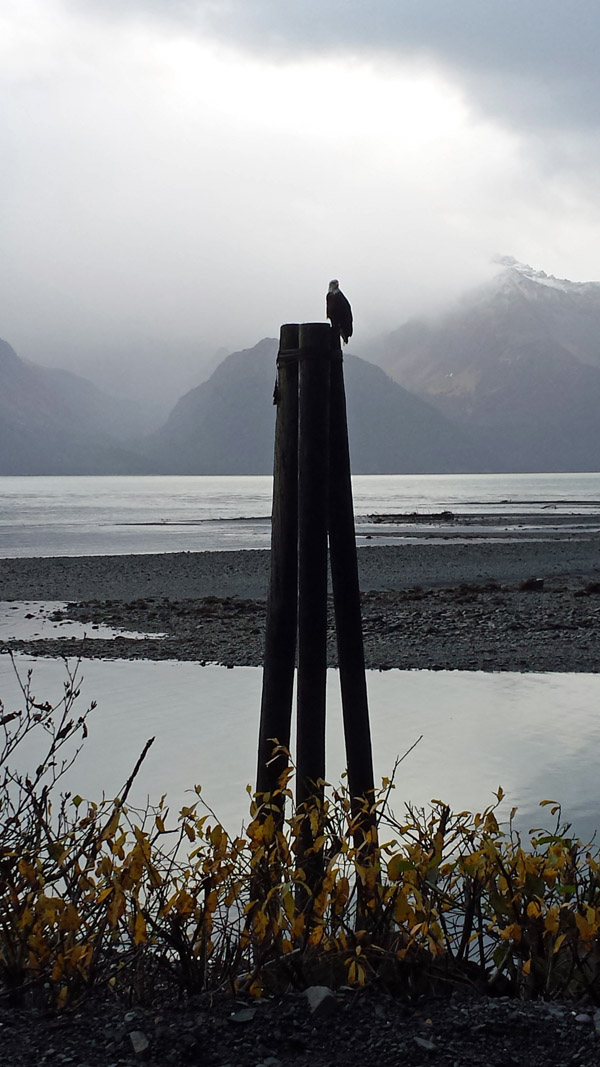
Someone thought it was a fine morning to perch and survey the digs:
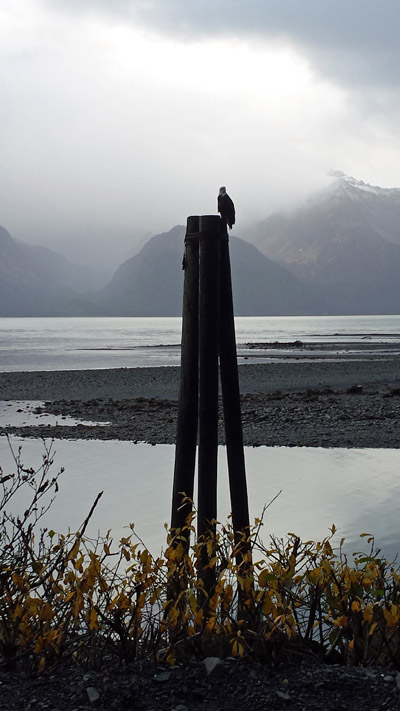
Across Resurrection bay there, maybe 5-6 miles as the eagle flies, lies Spring Creek Correctional facility, a high security prison. Robert Hansen is there. If you haven’t seen The Frozen Ground I can recommend it. Possibly the only movie about something Alaskan where most of the movie was actually filmed in Alaska. Anchorage, in the case of this movie. Cage is pretty convincing as the state Trooper investigating the murders, and Cusack was well cast as Hansen.
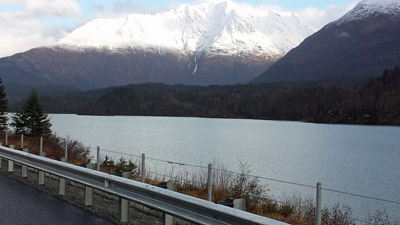
Later, near Trail Lake, on the way back to Anchorage, the sky had become far less surly. Now we can clearly see what all the commotion was about high up in the clouds earlier in the day.
Got up and going today earlier than usual. Happy Wife said, “I have to get to breast conference this morning.” Naturally, I thought, “Honey, you stay in bed, I’ll go in your stead.” nyuk nyuk. Didn’t say it out loud, the humor having long since run dry from overuse.
And so here I sit, in the kitchen, tapping away, awaiting inspiration. It’s dark outside and astronomers I’m told know why. Stinkin’ warm too — feels like an early day in May. Certain people claim they know why this is, too.
I was arguing on the internet again, this time about something I think know something about, what a rarity, right! Often I argue about things I know less about and I make mistakes but they say you aren’t learning unless you make mistakes so I’m not one to shy away from an exchange only because I’m less than optimally armed. Knowing I was intellectually well-armed this time around doesn’t mean learning was absent, it was just asymmetrical — I found myself in the role of teacher, or at least it felt that way to me.
The “discussion” was about the future, and revolved around a blogger’s contention that before too much longer, by extending a known current technology to guide a yet-to-be-demonstrated reproductive technology, parents of the future would be able to “pick ‘n choose” specific heritable traits they themselves express which they want their child to express — for example, say the wife is musically gifted and the husband is a good writer of fiction. Of course, like all people, our would-be parents have many other “traits” too — for the sake of example let’s say dad has a weak heart and mom suffers from a mild form of prospagnosia, she has some difficulty recognizing faces. Now, our would-be parents desperately want a little girl, and they want her to grow up to be a good musician like mom with an ear for good prose like dad, but at the same time, of course, they don’t want to endow the child any cardiac or neurological deficits.
Okay, so that’s the goal.
Now, to achieve this, the blogger described an approach he read about in a science fiction book. His idea was that if you have enough information of the kind that comes from modern-day genetic screens, a method that detects changes (“variants”) in a person’s genome that significantly associate with some trait, say musical ability in our example, why then we could use a future reproductive technology (see below) to make sure that good genetic variants make their way it into the child’s genome, and at the same time avoid any known bad variants from getting in, the ones that associate with bad traits, like a bad heart or face blindness. In this way, the blogger argued, the “Designer Child” grows up predisposed to becoming an harmonic flutist, say, and/or the next T.C. Boyle, possibly, with a sturdy heart and an un-compromised faculty for recognizing friends and family.
Now to the future reproductive technology, this is the hard part so stay with me here, I’ll be brief. The technology would involve using the list of genetic variants screened for above, those that are significant for both good and bad traits, and use them to guide a selective screen of DNA in dad’s sperm and mom’s eggs, depending on who has which good/bad trait. The idea being to isolate into one sperm and one egg as many good DNA variants as possible and as few bad DNA variants as possible. Then take that one sperm and egg, let them fertilize, implant the zygote in mom’s uterus (I suppose), stand back and let nature take it from there leaving our would-be parents ample time to prepare for the baby shower.
What’s the problem you ask? Here are the problems. Note especially comments signed by yours truly (“RKN”).
Enjoy your day!