Uncategorized

RIP Dad

Now I’ve written two obituaries in the past six weeks. My dad died September 30th. He was 94 years old; married to mom, who left us August 14th, for 74 years. Since 1952 those two were inseparable. Dad was born during the depression, seven years before Hitler marched on Poland. He’d seen a lot happen in this world. I took the omniscient third person point of view writing the obit. As one of his three children, I might have opted for the first person narrative point of view, although the reader of an obituary will want to read a recap of dad’s journey, not a story of my personal relationship to it. That, and I have two siblings, so even as I felt it a privilege to be invited by them to write the obit, as I had for mom after she died, I understood this was our dad I was writing about, not my dad. Still, my aim was to fashion it as a story, not a chronological fact dump. The operative word there being fashion. Imagine the ignominy I’d suffer here on earth were it discovered that I’d cheated and had an AI regurgitate the obit. Or dad’s scorn should he and I meet up again in the afterlife

Imagine

Where was I? On a mattress on a cold floor in a drafty downtown Anchorage apartment. My household goods had not yet arrived in Alaska. I’d left Santa Fe, NM about two weeks earlier, drove to Denver with Rufus, put him on a plane to Anchorage, and from there I continued driving the old Mercedes 300D to Seattle, where I put the car on a ferry and then flew to Anchorage. About two weeks later I’m awake on that shitty mattress, probably rubbing sleep dirt from my eyes, trying to make out what the girlfriend standing in the doorway was saying: …attacked…

Like most every other American alive on that day, 9/11 was transformative. But for me, personally, the good fortune of meeting HW at a wine tasting some eight weeks later was truly life changing. The change would come slowly, way too slowly, and I nearly screwed it up. I should have trusted my instincts then. Had I done so, the worldwide happiness quotient would haven risen by two whole points, years earlier than it did, when, eventually, we became inseparable

Death and destruction, love and joy, both are out there, immutable features of life on earth. Maybe there’s some place out there where we might experience less death and destruction? None at all sure would be nice. If I were the supernatural thing that had created everything, I would have made love and joy the constitutive experience of all life. With no propitiation or belief in me required. And I like to think I would’ve had the good grace to say just one thing to my creation: You’re Welcome

Be Humble

I have no creation stories to turn to, no end of times promises to soothe me. I look around at those who tell me they do, they are bawling their eyes out too. Gaians hold that Earth was born from mother, Gaia, and all the physical forms of Earth seem to us as features of a live organism. The crust is the skin, on which we exist as mites, busily moving about, spinning our teleologies, unaware of our cosmic insignificance. To pause and observe an ant mound at your feet is to understand that the order of life is fractal

Yet if the Earth were an organism why does it not divide? Answer me that smarty pants. You see, that’s arrogance. Arrogant derives from the ancient Latin word, arrogauns, to be insolent, overbearing, presumptuous. Some human brains, during the lifelong training phase, not unlike modern day artificial brains similarly trained, will represent false learnings about the real world. This is well known. Prompt an artificial brain high on its own supply, it will sometimes hallucinate. With the unaltered organic human brain, however, we don’t call it hallucination, we call it arrogance. The person who would insist reproduction is a necessary feature to be called life, is arrogant. Any human brain trained on anthropocentric beliefs may, depending on how you prompt it, exhibit arrogance. Sure, the Earth doesn’t divide, but that doesn’t mean it’s not a living thing. Maybe it lives on by recycling itself. Physical matter is re-created anew all the time on Earth. Human life is part of that physical matter, not apart from it. And stuff dies all the time. The ash is dispersed. Eventually it gets recombined. There’s something called organic chemistry. There’s something called the law of conservation. We understand that life energy cannot be destroyed in the closed system of Earth, only transformed

And that’s how I want to think about my Mom, humbly

Wistful

To be alive in this world is to exist in a kind of absurd melodrama. John Steinbeck was right when he concluded that an individual does not even understand what is happening to him from moment to moment. We can’t seem to help ourselves, ascribing some purpose to it all. Yet all our teleologies fail us. The revelation came to him while writing a log of his experience aboard the Western Flyer, combing the coastline of the Sea of Cortez with Ed Ricketts and a thin supporting crew, cataloging epipelagic sea life. Focus on the is, not the has or the what might be. Breathe. Things just is. Mattering is an illusion. Illusions aren’t useless, they can be temporary salves. Meditate. Where you exist in the moment in relation to no one else but the self. The infinite loop of breath and unbidden thought. It will frighten you at first, when you come to understand you cannot will the thoughts away. The activity of the brain is automatic, “your” purpose is not its purpose. Try it, you’ll see what I mean

In 21st century America, average life expectancy is near 78 years old, compared to one hundred years ago when it was about 60 years old. One hundred years ago about 400 children (in 100,000) would die before their 14th birthday. Worldwide, in the past 10,000 years, more than 100 Billion human beings have died. Way back when it was so bad that the average woman would have 6-8 live births expecting only 2 would survive. People die all the time and last week Friday it was my Mom’s turn. People will say she was 92, so at least she lived a good long life! Oh that we should all go as peacefully as she did! Strangely, none of that consoles me now. I love my mother. I miss my mother, greatly. My brain is thick with grief and there’s not a thing I can do to will it away

To Each From Each?

OK, so, the latest political boogeyman is The Democratic Socialists of America, DSA. Full disclosure: I have not read the official platform of the DSA. It is not a new political party in America, although until recently it has functioned mostly as an activist organization and not one that runs candidates in elections. A long time ago I read Socialism by Ludiwg von Mises. At a time in my life when the phrase ‘ hold your friends close, but your enemies closer’ was my credo. Quite the tome, it takes up nearly two inches on one of my bookshelves. I hauled it down recently and fanned through the pages. It felt like a walk down memory lane – I found dog-eared pages, scribbled marginalia, whole paragraphs highlighted in yellow. I’d devoured that text, the scholarship impressed me, required reading for every would-be libertarian. Along with Socialism, there are certain books on my shelves by libertarian-adjacent writers (e.g, Hayek, Rand, Nozick) that I will never part with. One of the main takeaways from these books was that Socialism, as a political system, is not one any freedom-minded citizen should ever want to live under. For the uninitiated, reading von Mises’ Socialism as a young adult was like the eye-opening experience of being skeptical that certain substances are really as poisonous as people claim, and then reading a meandering treatise on the toxicology of Ricin. I’m suspicious why this American variant of socialism prepends ‘Democratic’ to its moniker? Possibly it’s a gimmick, a kind of spoonful of sugar intended to ease the ideology into the heads of TheAmericanPeople who will hear ‘Democratic’ and think, That doesn’t sound so dangerous

Does the DSA pose a real threat? Many people say no, they point out that the DSA is popping up here and there like zits on a teen’s face, but there’s no reason to think it’s going to become full blown acne. Only 34% of polled Democrats say they align with DSA ideals. Even if some DSAers win their general elections and go to Washington, implementing their goals into law will be next to impossible. Bernie Sanders is nominally an Independent, while in spirit he’s an ideological Democratic Socialist, in a similar way that Rand Paul is nominally a Republican but in terms of political advocacy more an ideological libertarian (notwithstanding the recent charade with Fauci). In all the many years these two have served in the Senate, neither has meaningfully shaped policy. Even so, a lot of people are saying the DSA represents the Democrat’s version of the Republican’s Tea Party problem, we shall see

People I listen to describe the composition of the DSA party as mostly wistful college grads whose socioeconomic goal is to reinvent American life as a collection of fraternity and sorority houses complete with a planned economy, which the DSA would control. Basically, through the magic of nostalgia, they want to revive and relive their cushy college campus experience where everything was provided for them, where the grounds were kept neat and clean, where one was free to attend instruction (or not), or seek out a safe space where freed of the avarice wrought by Capitalism one might self-actualize in any way she sees fit. (By the way, this does not characterize my college experience during either of my two tours of duty in academia)! People like this are ideologues with no understanding (have never learned) how productive work gets done by wage-earning workers within the complicated socioeconomic system called America. They resent the present-day house of horrors in Washington D.C., sure, fine, we all get that, but unable to control their impulses they want to wholesale replace it with a system of government that would transmogrify the nation into a single amorphous organism maintained on life support via the magic of a planned economy. Each indivisible part of the organism will have its own, specific needs, of course, and yes, some parts will need to work longer and harder to fulfill the needs of others. To each’s need…from each’s ability… kinda thing

P. J. O’rourke once wrote about his experience on a Russian cruise. The story goes that many of his fellow-passengers trumpeted how great this or that Russian amenity or service was, and then, come to find out, to a one each of them had brought along his own toilet paper. There’s just no evidence that a planned economy has ever turned out well, kids. There are things called books, maybe download a few to your smart-reader and learn some history during your post-graduate honeymoon of self-actualization on some Grecian beach, or wherever

I can hear it already….eff off Boomer!

By now nearly everyone can at least understand the revolutionary zeal of the DSA. Toppling MAGA – starting in November with its metastases in both houses of congress, then continuing on in 2028 with the executive branch, followed by the DOJ and all the infected downstream agencies of government – is job one, no question. Yet almost nobody believes this will happen by nominating normie Democrats. And forget about normie Republicans coming to the rescue; DSAers, I’m sure, likely view them as part of the same elderly cabal of Do-Nothingers. Not to mention the fact that normie Repubs have all been banished or gone extinct

Reading about the Spanish civil war, I found myself sympathetic to one of two goals of the Anarchist faction, to get rid of Franco and fascism. But their subsequent ambition to abolish the State entirely, not so much. Today, the government of Spain is neither an Anarchy nor is it Socialist, it is a constitutional monarchy whose power is actively checked by a non-sycophantic, multi-party legislature known as parliament. Imagine that

Middler

In the right tail the pretty boys pursued the pretty girls, unsurprisingly the most popular girls, and in the left tail the unattractive high schoolers, variously talented to be fair, were terminally unpopular. That left around 70% of the student body in the pulchritudinous middle. A bulge +/- one standard deviation wide. An unexceptional cohort by every measure except their number

As one in the middle sometimes did, Russ would occasionally venture into the right tail and inquire of one of the pretty girls if she thought he might join her in the tail, or words to that effect. Such an entreaty was known as punching above your weight class, and a middling boy would know to expect some punch back from the competitive pretty boys. Regardless of his place in the distribution, every high school boy would eventually come to intuit which girls were in his league and which weren’t. Russ, however, was a slow learner, statistically speaking

He sat directly behind her in Mr. Tangel’s geometry class. He’d lean way back and slide forward in his desk chair enough that he could spy the lower half of her olive bare legs, the two-toned tan and crimson leather shoes with navy stitching, the two-inch stacked heel. High-class, pageant level sexy. And that taught and shapely cheerleader’s calf muscle, it was an isosceles triangle, rigid, hypnotic. Mr. Tangel threw the chalk at Russ busting him out of his reverie then barked at him to pay attention and the class turned to see and sneered at him and to this day he can still see triangles. Where consumption of the flesh was a sin surely mere window shopping wasn’t, was how Russ kept his conscience quiet, this was after all a religious high school and Russ and Jill being same-age minors, had she welcomed him into her tail and together they came to closure, and got caught, they may both wind up in jail, though not in the same cell, so no happy ending for Russ and Jill. Interfering thoughts like this arose in Russ’ mind unbidden all the time. He was a bit surprised he came away with a B+


Sometimes, after our ablutions, but before leaving for the restaurant we will step outside to enjoy an aperitif together. The still and quiet of an early summer evening, you can hear the Kingfishers whistle down by the pond. It’s become my favorite thirty minutes of leisure in the day

Carpe diem. The future is unknown

Original Sin

People will say, I no longer feel like myself

That’s because many years ago a large portion of the physical you was somebody else. Blood, guts, skin, bone, fat and muscle, all that stuff that makes you, you, has turned over countless times. Only the tissues of the brain, eyes, and heart are durable throughout life. God, it is claimed, founded humanity on Adam and Eve, as fully formed adults. If the account in Genesis is to be believed, Adam lived to be 930 years old (Genesis 5:5). Adam was 130 years old when his third son, Seth, was born, well after he and Eve had succumbed to the temptation of the serpent and were exiled from Paradise. That’s a lot of cell division! We would expect that at various times throughout his long life, Adam, too, may have lamented that he no longer felt like himself; indeed, that he felt reborn in a sense, many times over. Who wouldn’t? Possibly seeking a return to Paradise in his later years, he might have appealed to God that he was no longer that same person who disobeyed an order hundreds of years earlier. Biologically speaking, he would have had a point. And yet, evidently, God was having none of it. He would have reminded Adam that sin originates in the brain. He would have emphasized that by His Own Design the neurons of the cerebral cortex, the cells of memory, thought, and the sense of personality – neurogenesis aside – persist indivisible throughout a person’s life. Once a sinner always a sinner. All your descendants shall be cursed to inherit your Original Sin, Adam. And the same goes for your wife, too. So own it

The world would never be the same

So Seth was born a sinner? Yes, so the story goes, and everyone since, meaning of all of humanity. This requires a little unpacking, though. Perhaps you’re familiar with the phrase: The Sins of our Fathers? In Christianity, what inheriting Original Sin really means is that the newborn has inherited the guilt associated with the Original Sin committed by Adam and Eve, and being that this guilt is an inherited trait (according to canonical church teaching), passed down to all children since the dawn of man, it must, of course, be encoded in the newborn’s DNA (somewhere). In genetics, if 100% of the carriers of a DNA variant develop the corresponding disease, this is referred to as complete penetrance. Original Sin is an example of complete penetrance because every descendant of Adam and Eve – all of us, so the story goes – possess the trait of Original Sin at birth. However, according to Christian doctrine, there’s a cure, sort of. The infant afflicted with Original Sin may be baptized. Baptism is magical in the sense that the infant, spiritually, and biologically speaking, is cured, reborn. Baptism is seen as a kind of chemotherapy for the soul, I suppose is the way most Christians understand it. However – and here things get a little weird – while Baptism washes away the ancestral state of disgrace, according to canonical church doctrine it leaves behind in the infant the “tendency or weakness to sin.” In essence, baptism washes away the ancestral disgrace (Sins of the Fathers) but leaves behind the propensity of the baptized person to sin in the future. Getting baptized only removes the inborn sense of disgrace. Without that, the infant would grow up in a state of disgrace feeling as though she had committed the Original Sin herself. Surely, that would be a cruel curse of an unjust God. This segues us to the concept of Concupiscence

HW, raised Catholic, assures me she has never heard this term, or during her formative years learned what it means. It is, however, a concept central to the canonical teaching of both Protestant and Catholic churches, in terms of what baptism actually achieves, which so far as I can tell differ in their respective, abstruse descriptions of the metaphysical state the infant is left in after baptism. The differences need not concern us. Suffice it to say, both churches take seriously Concupiscence – that tendency or weakness to sin – as a constitutive vulnerability a person has throughout life, even if baptized. The concept is referenced at least three times in the King James bible. So what’s the big deal? The big deal, at least in my mind, is that baptism does not restore the infant to a state of grace before God. Baptism is merely a hall pass, it doesn’t get you out of school. And the propensity of a baptized person to sin in the future is held in check by another mysterious, corporeal endowment that Christians (especially, but not only) believe human beings possess, the exercise of free will

So as with chemotherapy, baptism doesn’t kill all the disease, the cure is short lived, babies grow up and may recur, the sin comes back. If your cancer recurs it’s not your fault. If you sin, though, the church will say it is your fault because you have free will. Free will means a human being is able to choose among alternative futures. If you choose to do a bad act, go against God’s will, you have sinned. It’s as simple as that. Recovery is still possible, but not through baptism, that’s a one time thing. You have to ask God to forgive you, repeatedly as often as the sin recurs, and, so the story goes, if you’re sincere, usually he will. If you die before asking God for forgiveness, bad things await you. This is why newborns are quickly baptized, to vanquish the Original Sin in case they should die before they are able to beseech God themselves to forgive it. If an infant is not baptized and dies suddenly, these are seen as edge cases; most church leaders will punt and say it’s God’s call if the child goes to heaven or hell

I am not without my critics on this. And I don’t mean Original Sin or its ramifications for a human life. I mean free will, or, for that matter any definition of will that proposes the material existence of a ‘judge’ or ‘volunteer’ in the brain, apart from the physical brain. For billions of people the sense (Seemings) of an act willfully chosen, of possessing agency, volition, the ability to choose among alternatives and thus change the future (if only locally), what have you, is viscerally felt, experienced. There is a large class of human actions that these same people will concede require no will, that don’t feel to us we had agency in causing. Such actions they will admit are automatic, instinctive, require no conscious thought to carry out. Yet somehow when the outcome of an action is good, well, then suddenly this is because of agency, choice, volition, my will, me me me, I did that! Which, for an Epiphenomenalist like myself, is nothing more than grandstanding, the chemical brain showing off, in effect manipulating you, the corporeal host, as its cheerleader. Weird as it seems there is at least some material evidence for this theory of mind. Of course the same phenomenon is in play when an outcome is bad. Except when you do something bad, now it’s: sorry “I” did that. Let the moralizing begin. Set in motion the means of Justice!

There is no organ in your body which, when it is dysfunctional, any sane person would claim is your fault, your error, you are the most proximate cause. Likewise, nobody would struggle to admit that the function of most organs in the human body is involuntary, that is, no willful thought is required to sustain the function, because it’s automatic (heart, lungs, liver, kidneys, etc.). And yet, somehow, a human being is the most proximate cause of the physical chemistry of one organ, the brain! Whether it functions to produce good or bad outcomes, no matter. Voilà! Epistemically speaking, that sounds suspiciously derivative of the claim of Original Sin, and equally unworthy of anyone’s serious consideration
Rite of Spring

A Fuzzy-horned Bumble Bee amid Rhododendron blooms

A Vanilla Universe

The past two days here have been unseasonably warm. Depending on who you ask, two unseasonably warm days in a row may be a portent of the end of times, or an unexpectedly delightful amuse-bouche of summer. HW leans toward the former, I the latter

Can you believe that May 1st marked three years since we moved here? Leaving Alaska and moving here involved an interdependent sequence of decisions on our part, of course, but in the larger scheme of things those decisions don’t feel, to me anyway, like choices, commonly understood. The past three years, and for that matter the past sixty-six years of my experience on earth, instead feels to me like it was predetermined. Not in any woo-woo spiritual sense, but in the sense that I don’t feel like I had agency directing the course of my life, where agency, as I understand what people mean by it, is the ability of an individual human brain to “choose” among alternative futures

Consider: I enter an ice cream store, place an order for a single scoop of vanilla in a waffle cone. In doing so, I choose a future state of the universe to be one in which I am seated outside on a park bench enjoyably lapping a vanilla ice cream cone. As opposed to an alternative state, where I am doing the same, except raspberry ice cream

Think about what work “I choose” is doing here, versus, simply (or not so simply!), “the speech center of my brain activated the vocal cords to activate the muscles of the mouth to form and speak the words (‘I will have vanilla’).” As a first take, many people will find nothing essentially different between the two descriptions of what’s going on. They may consider me daft, or excessively pedantic for the latter, but whatever. However, I would put it to you that those same people would insist there is something more going on upstream in the brain, more than just the laws of physics operating on material matter, the neuronal milieu, that would justify their defense of “I”

Most people would insist that “I choose” refers to something apart from the material brain, something in addition to it that interferes with the material universe, and in effect alters the state of the neurons in a manner not predictable – not even in principle – under the immutable laws of physics alone. Such people, in doing so, necessarily commit themselves to a belief in mysticism. I don’t mean that as a smear, merely as a way to call out two divergent beliefs that people hold regarding how nature works. Some of these people may push back on the charge of mysticism. They may acknowledge the laws of physics are real, yet say that there is something so incomprehensible about the human brain and how it works that it may as well be considered apart from the material universe. People like myself, however, who hold to strict, materialistic beliefs as to how all of nature works, will feel no urgent need to fill the gaps of uncertainty in modern neuroscience (there are many), certainly not with superstition

It’s not as if the atoms of carbon, in an amino acid, in a peptide, in a neuron, in the brain, interact any differently than the carbon atoms in a grain of dust on, say, Jupiter’s moon, Io. Both the neuron and dust grain are composed of elements on the periodic table and sourced from the ancestral matter. Both exist in the material universe. Both are subject to the same immutable laws of physics. Organization is different but so what. There is nothing controversial about any of this. If the immutable laws of physics can be used to predict the future state of a grain of dust, then surely, in principle, could the same could be used to precisely predict the future state of a neuron, and in due course be scaled up to the state of eighty-six billion of them. So by knowing the position and velocity of all particles at time T, that alone could, again, in principle, be used to predict the position and velocities of all particles at T+1, aka the future. And I would put it to you that that is all you’d need to precisely predict my vanilla future. Granted, it would be a lot to need to know; an incomprehensible lot to know, especially as the interval, T > T+1, becomes very, very small (a femptosecond, say). But think about what it would mean, so far as the human brain is concerned. It would mean that the brain is a transition state machine, that operates automatically in its representation of one state of the universe to the next. It would mean that I don’t choose my future because there is no “I” in the brain, no conductor pulling the strings as it were – that is: I don’t direct my thoughts, my brain automatically creates thoughts which direct my actions. It means that some time in the distant future our descendants will discuss among themselves how weird it must have been way back when for humans to think they were “responsible” for choosing their actions, believing they were apart from nature rather than part of it

Blessed

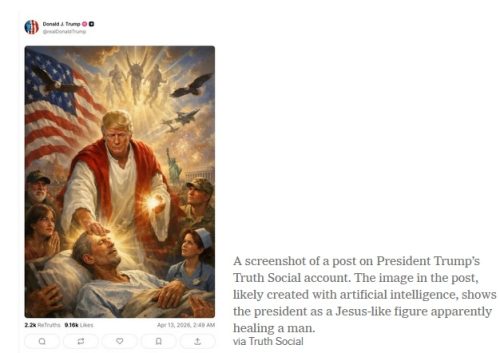
The POTUS was tweeting again, as usual from his personal perch on the world wide web, a well known, titular source of truthful pronouncements


Not noted in the caption is what the patient is afflicted with. I thought about that for a second and then – head slap – he’s sick with TDS, of course!

Now, can you even imagine if some rando blogger on the Internet, virtually unknown, had posted this AI-slop as a snarky way to slander Christians? Blasphemy! The POTUS does it and he earns thousands of likes. What’s up with that